

I published a new discussion paper for the Friedrich-Ebert-Stiftung, The Capability State: Delivering Beyond 2030, as part of their Beyond-2030 agenda. My paper focuses on the state at the heart of SDG goals. Simply put, while much of the focus has been on financing the SDGs, little to no attention has gone to whether the state conceptualised or assumed by such policies and instruments is actually capable of achieving them.
The key challenge of the modern state, at least in the Global North, has been aptly summarised by the historian Jakob Burckhardt when he observed a century and a half ago that the modern state is expected to be capable of everything yet permitted to do nothing. Another and perhaps more current form of this paradox is something I have called the accountability trap. Decades of public sector and management reforms, often captured by the catch-all of New Public Management (from privatisation, outsourcing, performance targets, value-for-money auditing, to the KPI craze and dashboard proliferation), were meant to make the state more responsible to its public and show us what we get for our increasing tax contributions. In reality, each new reform layer more often than not narrowed the space in which public organisations could act, and furthermore multiplied transaction costs, and hollowed out in-house expertise. The result is what I call in the paper capability black holes: places where authority formally exists but the capability to act has all but disappeared. Examples abound: a civil service asked to deliver an industrial strategy after thirty years in which industrial policy was quite literally forbidden; a health ministry asked to absorb AI safely after a decade of outsourcing its digital functions. Adding new goals or amending existing ones within such governance architecture will produce the same shortfall and indeed erode the public’s trust only further.
Why are we stuck? Partly for political or ideological reasons: a generation of reformers schooled in public choice theory treated government as inherently prone to capture and bloat. But the deeper reason is how we understand the economic theory underlying the public sector. As Mariana Mazzucato often argues, market failure theory frames the legitimate role of government as correcting identifiable failures and casts every other public action as suspect. Ironically, this supposedly neutral, market-fixing state presupposes a functioning public sphere (courts, regulators, civil services, public universities, democratic deliberation and media) that the same reforms have spent forty years and counting undermining. We are left with a theory of government that relies on a public sphere it can no longer call upon.
Instead, we should think of the state as the capability state, able to shape socio-technical systems and related markets towards desired outcomes. So, rather than think of specific markets and whether they function, the state should focus on its ability to deal with directionality in its various forms, as brilliantly described by Andy Stirling, understand learning — why and how we are reaching our goals, or not —, and see returns on public investments through their impact on systemic movement towards desired goals.
In the essay, I argue that such a view of the state requires, perhaps even more importantly, rethinking what innovation means. For the past century, we have seen innovation through the Schumpeterian lens of creative destruction, with technology shaping and reshaping our core societal systems from transport and energy to communication and production. In this view, the consequences of innovation, the destruction bit, are often left for the government to figure out. And so most public money goes into public services such as health, care, education, housing, and social protection, yet our innovation imagination is almost entirely coloured by the language and concepts of socio-technical systems like energy, industry, and digital. This has created a dual regime, with different economics and public sector capabilities: investment logic for technology, efficiency logic for services. That split is not only incoherent, because services and technologies co-evolve, but it is also outright harmful, because public services are where legitimacy is built or lost every day. Innovation in services is rarely creative destruction. It is the patient work of ordering, developing and maintaining. Treating innovation only as disruption misunderstands where most public value — and hence trust and legitimacy — is actually produced.
The paper builds on a three-layer view of public sector capability that runs through much of our recent work at the UCL Institute for Innovation and Public Purpose: structural capacities (constitutional mandates, fiscal rules, public investment instruments, digital public infrastructure, professional civil services), organisational routines (procurement frameworks, policy portfolios, HR rules, etc), and dynamic capabilities (sensing change, adapting priorities, building coalitions, learning, reconfiguring delivery). These layers only work together. When budgets are cut, or political authorisation erodes, this impacts organisational routines, learning becomes episodic, and the state does not merely shrink; it loses the ability to learn.
The capability state has three implications. On leadership, we need to move from the charismatic power broker, like NYC’s long-time urban leader Robert Moses in Robert Caro’s memorably telling, to the market shaper, whose distinctive task is to convert individual skill into durable organisational routine, distributed across elected leaders, appointed officials and career civil servants. On investment, public services should be treated with the same investment logic as physical infrastructure, with the public services workforce seen as a capability asset rather than a cost to be shrunk. On measurement, alongside “did we hit the KPIs?”, every significant initiative should ask: did we become more capable? Did we build partnerships that will be reused, codify lessons, change a routine so that the next change is easier?
For the Beyond 2030 framework itself, the paper’s central proposal is to pair every goal with a public sector capability dimension. Just as the SDGs paired targets with indicators, a new framework should pair them with benchmarks for the structural capacities, routines and dynamic capabilities needed to reach them. The table below illustrates what this could look like across six emblematic goals.
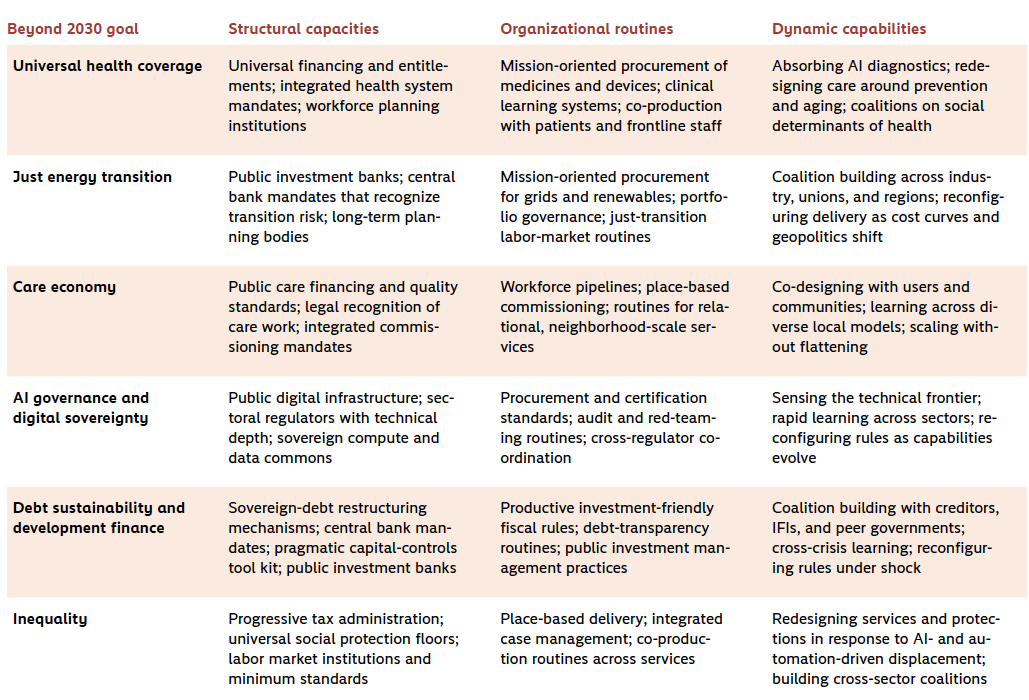
Table 1: Illustrative state capacity pairings for six Beyond 2030 goals. Source: The Capability State: Delivering Beyond 2030
Alongside this, the paper argues for redirecting development finance from investable projects toward building state capacity itself through rethinking IMF conditionality, debt restructuring and trade rules so they enable rather than constrain that capacity, treating it as a development right; funding peer learning networks between civil servants in Nairobi, Bogotá, Berlin, Jakarta and Seoul; and making the welfare state, still under construction in much of the Global South and eroding in much of the North, the strategic infrastructure on which decarbonisation, AI governance and security succeed or fail.
In brief, the next decade's deepest reform task is to rethink and rediscover public accountability. The frameworks built over the past forty years were meant to make the public sector responsible; in practice they made it incapable. The SDGs showed that the world can rally around a shared purpose. The task now is to give that purpose a state capable of delivering it.
The discussion paper is here: https://ny.fes.de/topics/publication/the-capability-state-delivering-beyond-2030.html.