
How Do Governments Learn?
Governments were built to deliver no surprises. Their environments now deliver almost nothing else.

The Radiohead song “No Surprises” could serve as the unofficial anthem of what governments do and are: make sure businesses and citizens are not surprised negatively by anything you are responsible for — from the environment to security —, and also have a quiet and a steady routine life internally. It is sung, of course, as an indictment — the quiet life as a kind of slow suffocation. I think that double meaning captures something quite essential about the predicament of governments today. Public organisations were predominantly built to deliver no surprises. Their environments now deliver almost nothing else. And while governments take their time — rightly so — to figure out what to do, say, with AI or migration, for many this feels either like negligence or too little too late. That’s why, perhaps, the Radiohead song also includes the following call for action: “Bring down the government // They don’t, they don’t speak for us“. There seems to be an increasing number of people around who think like that.
Simply put, the key challenge for governments today is learning in fast-moving environments — how to become learning organisations while remaining accountable, procedural, predictable and fair. This is harder than it sounds, because the ways governments learn were designed for a slower world.
Two ways of learning
Governments have, broadly, two learning approaches.
The first is expertise. Government is founded on the idea of expertise, and expertise is by, definition, a slow process. Obtaining it requires years of study and practice; applying it requires care, deliberation, and the weighing of options. Essentially, though, expertise is almost always front-loaded learning (what you learned while studying), and this is also what civil service exams have tested for a thousand years. In the office, such learning is deepened and embodied by research teams or even institutes, by appraisal and evaluation functions, by business case and project management guidance manuals. It is learning as accumulation: knowledge is built up, codified, and applied through structured processes. And it is genuinely valuable — much of what makes government trustworthy rests on it. That’s how we know pollution is bad for us, and so forth. But it is slow. By the time a rigorous evaluation report arrives at the desk of key policymakers, the policy landscape may have moved on, and almost certainly the policymakers have moved on; by the time a business case is signed off, the problem it addresses may have changed.
The second approach is what we today call user feedback, and it has grown enormously in importance over the past two decades, particularly through digital government agencies and the application of design methodologies in public policy. User feedback can be very quick: prototyping and testing compress learning cycles from years to weeks; large-scale data analysis reveals in real time how citizens actually use services. And there is an older, often overlooked form of the same thing — street-level bureaucracy, the accumulated sense and understanding that frontline workers develop of the citizens they serve. Nurses, caseworkers, and job centre staff learn continuously, whether or not anyone asks them what they know.
These two approaches can be seen as complements — slow, deliberate expertise supplemented by fast, real-life feedback. Increasingly, though, they sit in tension, even juxtaposition. Digital teams grow impatient with appraisal processes; business case evaluators grow suspicious of iteration that never stops long enough to be assessed.
Each approach carries its own challenges, of course.
Expertise is by definition hierarchical. Someone decides what counts as expertise, who has access to it, and whose knowledge is admitted into the category at all. The economist’s model enters the business case; the frontline worker’s experience-based pattern recognition rarely does. Learning through expertise is therefore always also an exercise of power — it filters what the organisation is allowed to know, or wants to know.
User feedback has the opposite problem: it is radically empirical, often embedded in real-world experience, but often also narrow or shallow. Feedback typically captures one aspect of a service, and what it captures can be a function of factors that have nothing to do with the service itself — inequality above all. If certain groups do not use a service, do not complete the journey, or do not respond to the survey, the data does not register their needs. Fast learning can easily be a learning from a structurally distorted sample.
So governments face a genuine dilemma: their deep learning is slow and hierarchical, and their fast learning is quick but partial. Neither, on its own, is adequate to environments that we are routinely facing today, fundamental uncertainty coupled with informational overload. And combining both approaches rarely happens in practice as routines required to do so are so different.
Forgetting, organised and otherwise
There is a further complication, and it is where the story becomes perhaps more puzzling: governments do not only learn. They also forget — and sometimes they forget on purpose.
Josh Entsminger’s excellent work on high-risk, high-reward agencies shows what we might call organised forgetting: agencies like DARPA are deliberately structured not to accumulate too much institutional memory (Josh’s completed PhD should go online soon). Rotating programme managers, sunset clauses, thin permanent staff — these are devices for shedding knowledge as much as acquiring it. And this is not an accident. Institutional memory is also institutional caution; an organisation that remembers every past failure in detail will find reasons not to take the next risk. Forgetting, organised well, is what enables risk-taking.
But forgetting can also happen to governments rather than by them. Rosie Collington’s work — in her PhD and in The Big Con with Mariana Mazzucato — identifies what she calls adaptation decay: the erosion of learning capacity that occurs when learning itself is outsourced. When consultants do the analysis, the analysis gets done, but the capability to analyse does not accumulate inside the state. The organisation processes information without understanding it. Over time, government loses not just specific knowledge but the ability to know — it forgets how to learn.
And there is a third form of forgetting: politics itself. The art of convincing others is messy — driven by conviction and personal relations, by coalitions and betrayals, by the pursuit of power. All of this rests on a foundational assumption: that no one has final control over what is right and wrong, and that we must therefore be able to move on, even with imperfect or plainly wrong solutions. Politics, in other words, is a form of accepting ignorance as much as it is a form of learning. Every election, every reshuffle, every change of government is a licensed moving-on — a mechanism by which a polity releases itself from its own past conclusions. Thus, it legitimises the choice we make about learning inside government.
So forgetting cuts both ways. Sometimes it is generative, clearing space for experimentation; sometimes it is decay, hollowing out the very capacity to adapt. The question is what distinguishes the two — and the answer, I think, is that generative forgetting is a choice made by an organisation that retains control over its own learning, while decay is what happens when that control has been given away.
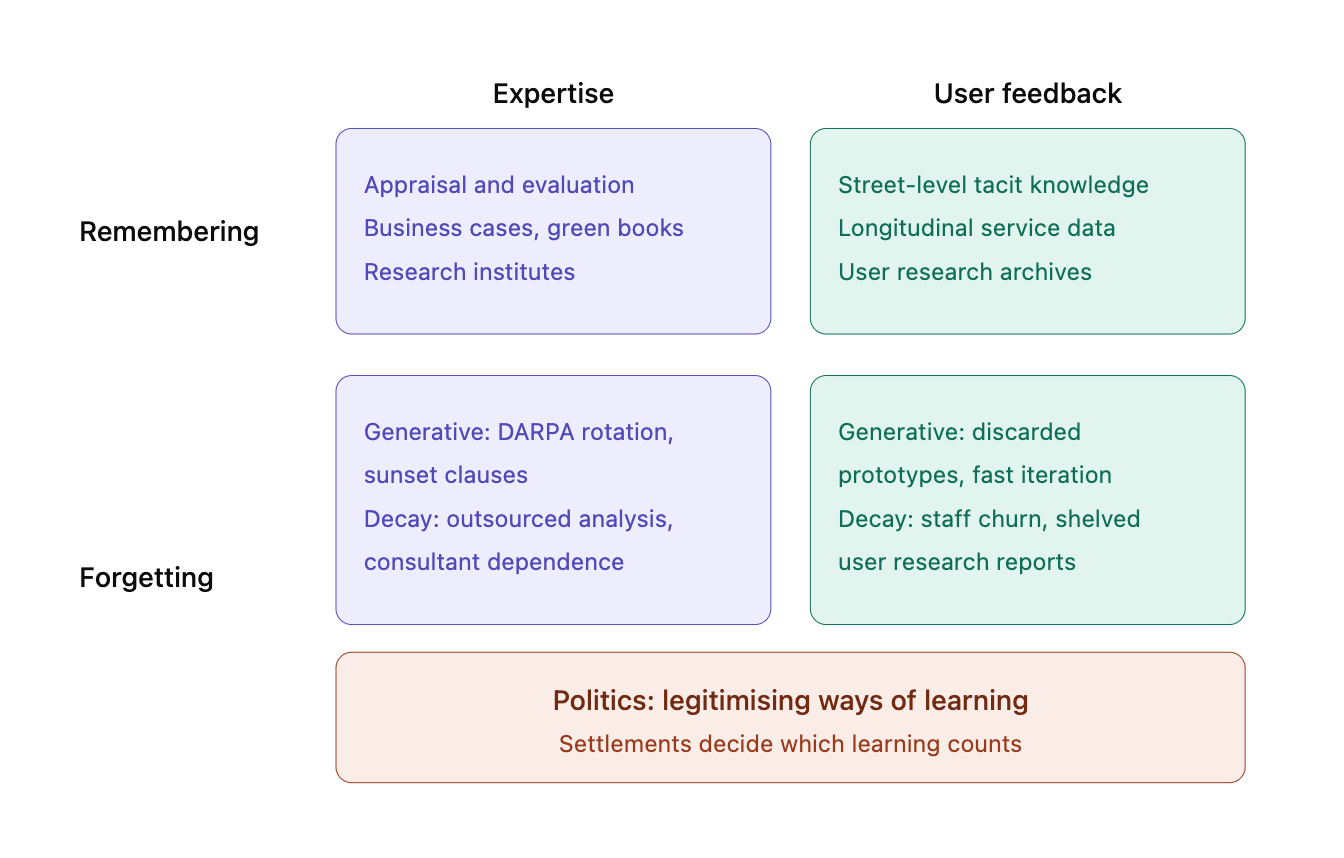
We can sketch a very simplified typology of learning in government, depicted below, in which political settlements legitimise whatever approach to learning and forgetting tends to dominate:
Adaptivity: what switches learning on
This more nuanced picture — learning and forgetting, fast and slow, generative and degenerative, all of it legitimised or delegitimised by shifting political settlements — points to a concept we know from evolutionary biology: adaptivity. What matters in evolving systems is not the stock of accumulated traits but the capacity to switch adaptation on when the environment demands it. The interesting question about government learning is not “how much does the organisation know?” but “what activates its learning, and what suppresses it?”
In our work at IIPP on public sector dynamic capabilities, we place this among the five core dynamic capabilities, with a particular focus on experimentation. But adaptivity is a somewhat broader concept than experimentation alone. It speaks to the context and ecosystem of learning: whether the surrounding structures — budgeting rules, evaluation guidance, career incentives — reward an organisation for noticing that its environment has changed, or punish it. An agency can have superb policy evaluators and/or brilliant service designers and still fail to learn, because nothing in its day to day work switches the learning on.
Simply put, governments should not choose between slow and fast learning, between expertise and feedback, between remembering and forgetting. They should build multiple learning approaches into every team — economists alongside ethnographers, policy evaluators alongside designers, people who ask what should work alongside people who observe what does. Adaptivity is thus not so much an intangible organisational trait but rather a conscious decision to enforce diversity of learning approaches into everyday organisational environments. This means the way we build teams and departments should focus less on expertise and competencies alone but increasingly combine these in a way that makes sure the diversity of learning approaches is present in everyday activities of any team and department.
A learning government, in other words, is not one that has eliminated surprises. It is one that has stopped fearing them — because it has built ways to deal with them. The quiet life, as the Radiohead song reminds us, is not the same as a good one.
This was excellent - I wrote something very similar here in my assumption archaeology series, drawing heavily from IIPP's work: https://thepolicyminaret.substack.com/p/peer-reviewed-research-is-more-reliable
Rainer, I'm not trying to be difficult here - and I think your point about forgetting is critical (my watchword is simple: central goverment should be considered to have no institutional memory).
But I think your post might better be called 'formal ways that government learns'.
To coin Nora Bateson's phrase, I think you're discounting all the many ways that learning is going on actively to keep things exactly how they are! And a lot of that is individual informal learning and socialisation within the civil service, included selection - and rejection.
I still hear civil servans talk about 'the Daily Mail test' - that means they've learned and internalised (for good and ill) the importance of weaponised political 'takes' on government activity.
I still remember the lessons learned by the positive, inclusion internal reform movement 'OneTeamGov' as they were - without much intent or thought - frequently put 'back in their boxes' by the rest ofthe civil service around them.
You could say this is just social reproduction (as so well illustrated by Bernard and Sir Humphrey) - even if so, I think this is important to include here!